
A property buyer in Monrovia does not call the first agency that comes to mind. Before any inquiry gets made, whether that’s a WhatsApp message, a phone call, or a walk-in, that buyer has already spent time looking: searching the agency’s name, checking whether a website exists and what it shows, deciding whether the listings look current or stale.
That check either builds enough confidence to make contact, or it does not. Most agencies never see the buyers who quietly decided not to reach out. When an agency has a useful website, it can become the place where a buyer moves from simply verifying the business to evaluating a specific property in detail, which is why the website plays a central role in this article.
The visibility journey: Discovery, Verification, Property Evaluation, Trust, Contact
A buyer’s path to contacting an agency generally runs through five stages:
- Discovery, how the buyer finds out the agency exists at all
- Verification, deciding whether the agency looks active and legitimate
- Property Evaluation, whether the buyer can actually assess a specific property before reaching out
- Trust, the signals that make the agency feel safe to deal with
- Contact, how easy it is to actually reach someone once the buyer is ready
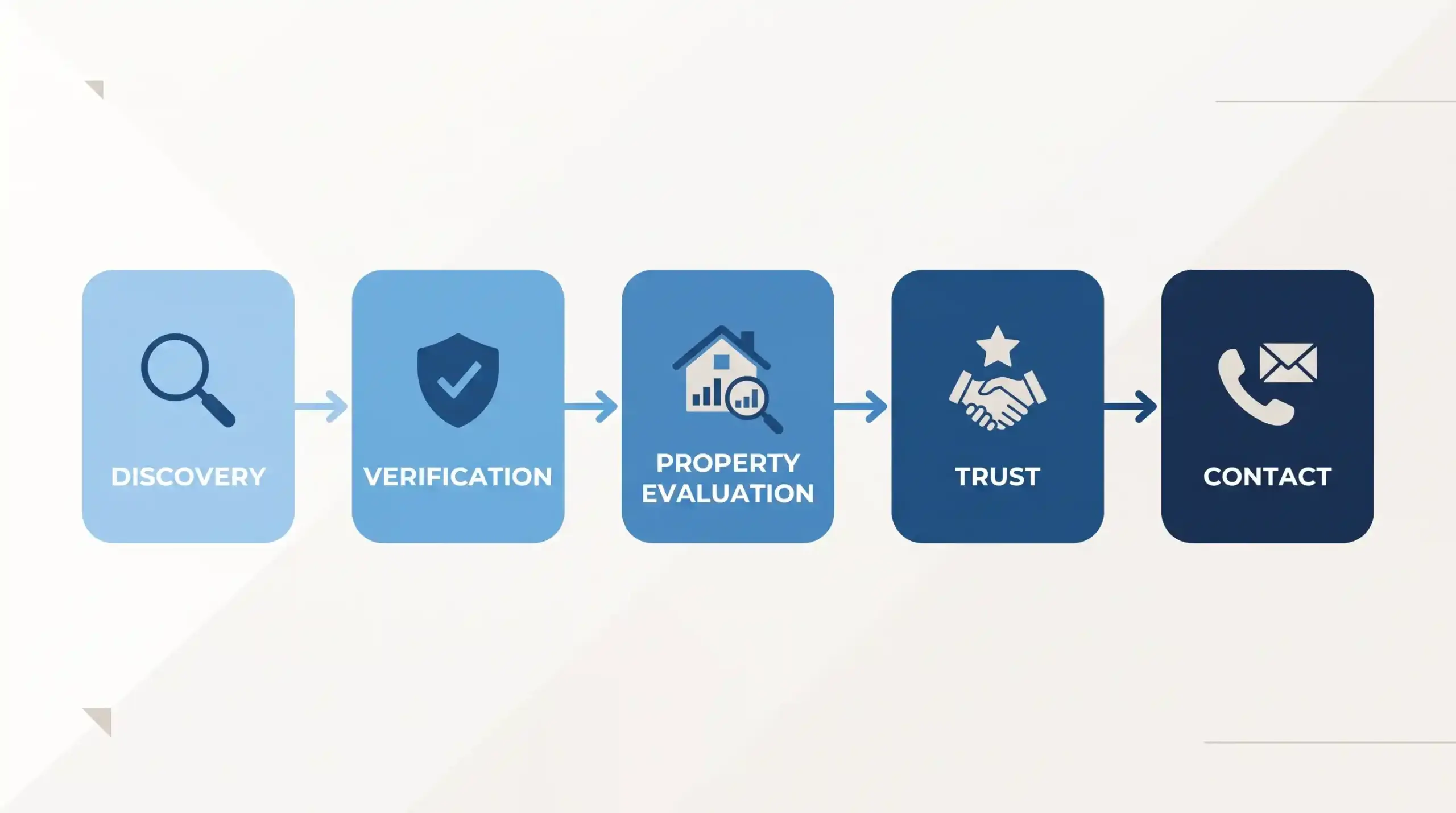
Each stage can lose a buyer who would otherwise have made contact. The rest of this article works through what “ready” looks like at each one, and where the agency’s own website carries real weight.
Discovery, how a buyer finds the agency exists
Discovery happens across a mix of channels: search engines, Google Business Profile, Facebook, referrals, classifieds.
Liberia had an estimated 1.73 million internet users as of October 2025, about 30% of the population, and roughly 1.1 million social media user identities. Facebook had substantially greater reported advertising reach than the other major platforms covered in the report, ahead of Messenger, LinkedIn, and Instagram, although DataReportal notes that advertising-reach figures should not be treated as monthly or daily active-user counts (DataReportal, Digital 2026: Liberia). Google Business Profile is separately confirmed as supported in Liberia (Google Business Profile Help, supported countries/regions list).
Those figures show where broad digital reach exists in Liberia. They do not establish exactly how property buyers specifically divide their research among Facebook, Google, agency websites, referrals, classifieds, WhatsApp, or other channels.
For an agency, the practical conclusion is that its website, Google Business Profile, and Facebook presence should reinforce one another rather than contradict one another or appear abandoned, since there is no clear evidence yet pointing to one channel as the primary discovery path for property buyers specifically. For more on how AfrikaBase approaches this vertical, see AfrikaBase’s Real Estate & Property page.
Verification, deciding whether the agency is worth pursuing
Once a buyer finds an agency, the next question is whether it looks real and active. This is decided quickly: a current phone number and hours on Google Business Profile, listings on Facebook posted within the last few weeks rather than months ago, and a website that loads properly and looks maintained all factor into that impression. An agency that is easy to find but looks abandoned once found creates another reason for the buyer to stop before any property has even been discussed.
Property Evaluation, where the website carries real weight
A well-structured agency website gives the business a controlled place where buyers can compare listings and evaluate details such as price, location, photos, size, and availability before starting a conversation. A social post or a directory listing can tell a buyer an agency exists, but a website can go further: consistent structure, easier comparison across listings, and a level of detail that’s harder to maintain inside a social feed or a general business listing.
Without that structure, basic questions, such as whether a property is still available, its price, or its exact location, often have to go through a direct message. Every extra information gap creates another point where a prospective buyer can stop the process before a conversation even starts.
Trust, what makes an agency feel safe to deal with
Trust signals build on top of verification and property evaluation rather than replacing them: reviews on Google Business Profile, a professional and consistent presentation across the website and social channels, clear ownership or business information, and no obvious inconsistencies between what’s shown on Facebook, on Google, and on the website itself. Inconsistent business information, outdated listings, or unclear ownership gives a buyer more uncertainty to resolve before contact.
Contact, removing friction at the final step
By the time a buyer reaches this stage, they’ve already decided the agency is worth contacting. The only remaining question is whether that’s easy to do: a working phone number, a contact form that actually sends, a clear WhatsApp link if that’s how the agency wants to be reached. A buyer who has made it through Discovery, Verification, Property Evaluation, and Trust should never lose interest because the contact method itself is broken or unclear.
An illustrative example
Consider two hypothetical agencies, both appearing in the same number of searches for property in Monrovia. This is an illustrative scenario built to show how the stages interact, not observed data from a Liberia engagement.
Agency A has a working website with current listings, an active Google Business Profile, and a Facebook Page posted within the last week. A buyer can evaluate two or three properties directly on the site before ever messaging anyone, then reaches out already informed and ready to move forward.
Agency B is discoverable through the same searches, but has no website, an outdated Facebook Page, and no Google Business Profile. A buyer finds the name, cannot verify whether it’s still active, and has no way to evaluate a specific property without messaging first. Some buyers may still send that message. Others may decide the extra effort is not worth it and continue comparing other options.
Both agencies may see similar numbers of people search for them. What differs is how many of those people ever reach the Contact stage, and that gap is a visibility problem, not a sales problem.
Conclusion
A buyer’s decision to contact a property agency takes shape before that buyer sends a single message, built from what they found across Discovery, Verification, Property Evaluation, and Trust, with the agency’s own website carrying real weight once a buyer reaches the Property Evaluation stage. The practical next step is not to assume which of these stages is weak and jump straight to a new website, an SEO project, a social media push, or paid advertising. It’s to find out first. A Visibility Assessment exists to answer that question directly: how the agency is currently discovered, what prospects find when they verify it, whether property information can be evaluated easily, whether trust signals are present and consistent, and whether the path to contact contains obvious friction, then prioritize what’s worth addressing first.
This article deals with what happens before the inquiry. Once customers are contacting the agency consistently, how a typical property inquiry moves from first look to first contact becomes a separate operational question: whether those inquiries are captured, answered, routed, and followed up reliably.
Request a Visibility Assessment: Find out where prospective buyers are dropping off before they ever contact you, across discovery, verification, property evaluation, trust, and the path to contact, then get a prioritized list of what to fix first.
FAQ
Does Google Business Profile work for real estate agencies in Liberia?
Yes. Liberia is listed among Google’s supported countries for Business Profile, so an agency can set up hours, contact details, photos, and reviews the same way businesses do in other supported markets. Source: Google Business Profile Help, supported countries/regions list.