
If you run tours or experiences, getting a traveler interested is only half the job. Once someone says “yes, I want to book,” there’s usually still a round of back-and-forth to actually lock it in, confirming the date, the group size, who’s paying, what’s included. That coordination isn’t unusual; it’s just part of finalizing a trip. What separates an operator who converts that interest into a confirmed booking from one who watches it quietly stall isn’t whether coordination is needed. It’s how many places that coordination has to happen across before it’s actually done.
Why Finalizing a Booking Takes More Than One Message
A traveler rarely books in a single message. There’s usually a sequence: confirming availability for their exact dates, working out group size and pricing, sorting payment, and answering a last question or two about logistics before it’s actually locked in. None of that is a red flag, it’s just what booking an experience in advance normally looks like.
The friction shows up when that sequence happens across scattered channels, a WhatsApp thread here, an email there, a comment on an Instagram post, with no single place tracking where a given traveler actually is in that process. For most tourism businesses, coordinating the last steps of a booking isn’t an occasional hiccup. It’s a recurring, manual task for every interested traveler, every week.
How It Actually Plays Out Operationally
For most tourism businesses, the sequence looks something like this:
- A traveler confirms they want to book and asks a follow-up question, group size, payment method, meeting point.
- Someone on your team replies, often from memory rather than a tracked record of where this particular booking stands.
- The traveler responds on a different channel than the one the last message came through, or after a delay long enough that details need re-confirming.
- Staff piece together the conversation across channels and memory to figure out what’s actually been agreed to and what’s still outstanding.
- Somewhere in that back-and-forth, a traveler who was ready to book loses momentum and the booking quietly stalls, not because they changed their mind, but because finishing it took more effort than it should have.
No single step in that sequence looks like a failure. The failure is that nothing is tracking the booking as a whole, so every step depends on someone remembering where things left off.
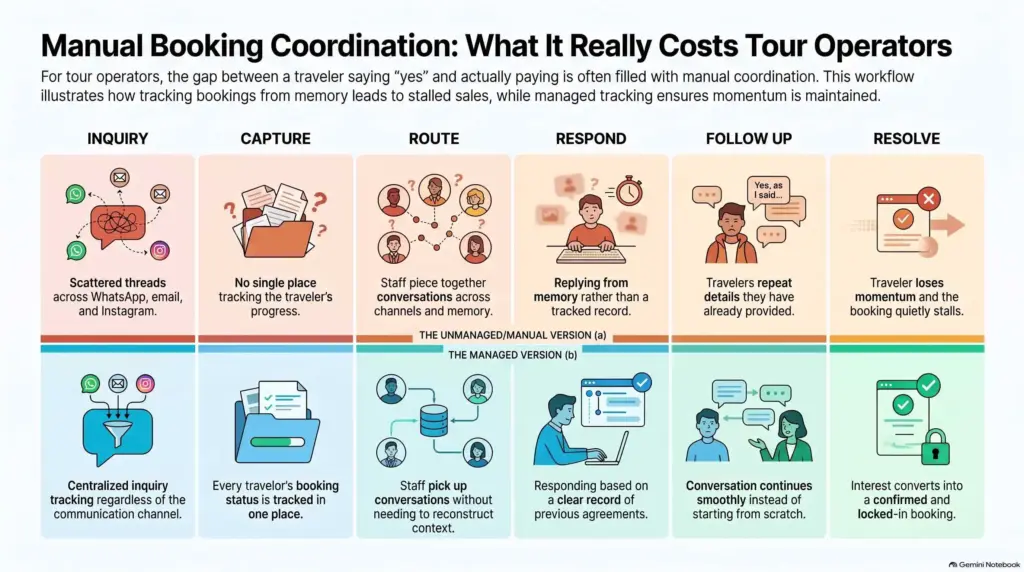
It’s Not the Coordination, It’s Tracking It From Memory
Here’s the pattern worth sitting with: the cost isn’t that finalizing a booking takes a few messages. It’s that those messages happen across different channels with nothing connecting them, so every step requires someone to reconstruct the conversation instead of just picking up where it left off.
From inside the business, each follow-up feels manageable on its own, “I’ll just check what we last said.” But across a full pipeline of interested travelers, all at different stages, that reconstruction work adds up, and it’s exactly the kind of friction that causes an almost-booked traveler to drift instead of confirming.
Meanwhile, the traveler experiences it as inconsistency, having to repeat details they already provided, or waiting while someone figures out where their booking actually stands.
What Manual Booking Coordination Actually Costs
For a tourism business, coordinating bookings manually across channels tends to show up in a few concrete ways:
- Interested travelers who quietly stallsomeone ready to book can lose momentum when finishing the process takes more back-and-forth than expected, even without ever saying they’ve changed their mind.
- Staff time spent reconstructing contextpiecing together what’s already been confirmed and what’s still outstanding takes real time, especially when the conversation spans more than one channel.
- No visibility into where bookings actually standwithout a tracked view of every traveler’s stage in the process, there’s no reliable way to know which ones need a nudge and which are simply waiting on the traveler.
- Peak season compounding the loadwhen interest is highest, the number of bookings mid-coordination rises at the same time staff have the least spare capacity to track them all from memory.
The Fix Isn’t Chasing Harder, It’s Not Losing Track
Following up more aggressively doesn’t fix the underlying pattern, it just adds more manual effort on top of an already manual process. What actually closes the gap is simpler: every interested traveler’s booking status is tracked in one place regardless of which channel they message from, so picking up a conversation doesn’t require reconstructing it first.
That doesn’t mean losing the personal back-and-forth that finalizing a trip often needs. It means that back-and-forth builds on a clear record instead of starting from scratch every time.
If you’re not sure how many almost-booked travelers are currently sitting in limbo, or how much staff time goes into tracking bookings manually, that’s exactly what a Customer Inquiry & Follow-Up Assessment is built to show you.
Take a few minutes to walk through your current booking process and see where things are stalling. Start your free Customer Inquiry & Follow-Up Assessmentno obligation, just a clear look at what’s working and what isn’t.
Frequently Asked Questions
How many bookings do tour operators actually lose to stalled coordination?
It varies by business size, booking complexity, and how many channels travelers use, so there’s no single figure that applies everywhere. What’s consistent is the pattern: a traveler who has to repeat themselves or wait for someone to catch up is more likely to lose momentum than one whose booking moves forward smoothly.
Does fixing this mean using fewer communication channels?
No. The goal isn’t restricting which channel travelers use, it’s making sure wherever they message from, their booking status is already tracked, so the conversation continues instead of restarting.
Which channels does booking coordination usually happen across?
Most spans WhatsApp, Instagram, email, and website forms, often for the same traveler, since people don’t always stick to one channel between their first inquiry and final confirmation.
How can a tour operator find out how many bookings are currently stalled?
The most reliable way is to track every interested traveler’s stage in the booking process and how long they’ve been there, rather than relying on staff memory of who still needs a follow-up. A Customer Inquiry & Follow-Up Assessment is built to surface exactly that.
Not sure how many bookings are stalling in your process right now?
A free Customer Inquiry & Follow-Up Assessment shows you exactly where communication gaps are costing you bookings, time, and traveler trust.