
If you run a hotel, guesthouse, or restaurant, you already answer the same handful of questions constantly, room rates, availability for a date, check-in time, whether you allow pets. That’s not a sign anything’s wrong. It’s just how guests shop. What separates a property that handles this smoothly from one that’s constantly playing catch-up isn’t whether these questions come in. It’s whether answering them once means answering them once, or answering them fifteen times a day across five different places.
Why the Same Questions Keep Coming In
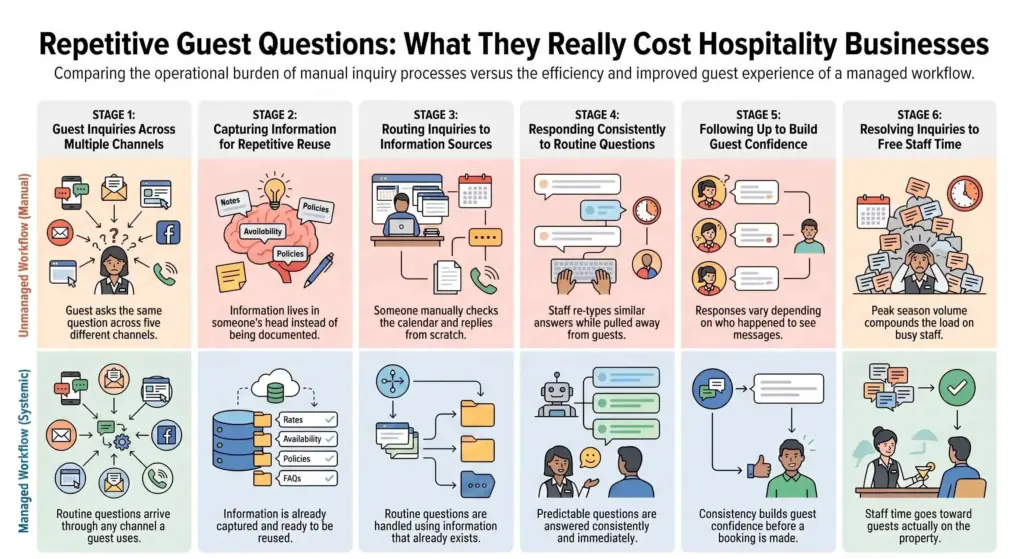
Guests rarely check one channel before reaching out. Someone might see a photo on Instagram, message you there, then also fill out the website contact form, then also message on Facebook, not because they’re testing you, but because they’re not sure which one you actually check. Each of those messages usually asks some version of the same thing: is this date available, what does it cost, what’s included.
Multiply that by every guest shopping around, and the volume of repeat questions isn’t an occasional annoyance. For most hospitality businesses, it’s the majority of pre-stay contact, the same handful of questions, asked constantly, across every channel a guest happens to be using that day.
How It Actually Plays Out Operationally
For most hospitality businesses, the sequence looks something like this:
- A guest asks about rates or availability on WhatsApp. Someone checks the calendar and replies.
- A different guest asks the exact same kind of question on Facebook an hour later. Someone checks the calendar again and replies again.
- A third guest fills out the website form asking about pet policy, information that’s been answered a hundred times before, just never written down anywhere staff can point to.
- Whoever’s on shift ends up re-typing similar answers throughout the day, pulled away from guests who are actually on the property.
- When that staff member is busy or off shift, the next message in any of these channels waits until someone else has a free moment.
No single one of these messages is a problem. The problem is that there’s no single place where the answer already exists and can just be sent, so every question starts from scratch.
It’s Not the Question, It’s Answering It From Scratch Every Time
Here’s the pattern worth sitting with: the cost isn’t any individual guest question. It’s that the same information, rates, availability, policies, gets manually re-typed over and over because it lives in someone’s head instead of somewhere it can be reused.
From inside the business, each reply feels routine, “just answering a quick question.” But across five channels and dozens of guests a week, that routine work adds up to real hours spent re-explaining things that haven’t changed since the last time someone asked.
Meanwhile, guests experience it as inconsistency: a fast, confident answer from one channel and a slower or slightly different one from another, depending on who happened to see the message and how busy they were at that moment.
What Repetitive Guest Questions Actually Cost
For a hospitality business, manually answering the same questions across channels tends to show up in a few concrete ways:
- Staff time spent re-explaining, not hostingtime that could go toward guests on the property instead gets spent retyping the same rates and policies to guests who haven’t arrived yet.
- Inconsistent answers across channelsdifferent staff members answering the same question slightly differently can quietly undermine guest confidence before a booking is even made.
- No visibility into what’s actually being asked mostwithout tracking which questions repeat most often, there’s no clear signal for what should be answered proactively on the website or listing instead of one message at a time.
- Peak season compounding the loadduring high-demand periods, the volume of repeat questions rises exactly when staff have the least spare time to answer them.
The Fix Isn’t More Staff, It’s Not Starting From Scratch Every Time
Adding more people to answer the same questions faster doesn’t fix the underlying pattern, it just spreads the repetition across more people. What actually closes the gap is simpler: the routine questions, rates, availability, policies, get answered consistently and immediately from information that’s already captured, across whichever channel the guest happens to use, so staff time goes toward guests who need a real answer or are actually on the property.
That doesn’t mean losing the personal touch. It means the predictable 80% of questions stop competing with the 20% that actually need a person’s judgment.
If you’re not sure how many repeat questions your team is fielding across channels, or how much time that’s actually taking, that’s exactly what a Customer Inquiry & Follow-Up Assessment is built to show you.
Take a few minutes to walk through your current guest inquiry process and see where the time is going. Start your free Customer Inquiry & Follow-Up Assessmentno obligation, just a clear look at what’s working and what isn’t.
Frequently Asked Questions
How much time do hospitality businesses actually lose to repetitive guest questions?
It varies by property size, channel mix, and how much information is already documented for staff to reuse, so there’s no single figure that applies everywhere. What’s consistent is the pattern: each reply feels quick individually, but the same questions repeated across multiple channels add up to more time than most properties realize.
Does fixing this mean guests stop getting a personal response?
No. The goal is to handle the routine, repeated share of questions, rates, availability, policies, consistently and immediately, so staff time goes toward guests who need real judgment or are already on the property.
Which channels do repeat guest questions usually come through?
Most arrive across WhatsApp, Facebook, Instagram, and a website contact form, often from the same guest using more than one channel because they’re unsure which one you actually check.
How can a hospitality business find out how much time repeat questions are actually taking?
The most reliable way is to track incoming questions across every channel and how long each one takes to answer, rather than relying on a general sense that “we get a lot of these.” A Customer Inquiry & Follow-Up Assessment is built to surface exactly that.
Not sure how much time repeat questions are actually costing your team?
A free Customer Inquiry & Follow-Up Assessment shows you exactly where communication gaps are costing you time, consistency, and guest trust.