
If you run a freight forwarding or shipping business, “where’s my shipment” is one of the most common messages you get, and it’s not a complaint. It’s a normal question from someone who’s sent something valuable and just wants to know it’s on track. What separates a smooth operation from an overwhelmed one isn’t whether customers ask about status. It’s what it costs your team to answer that question, over and over, for every shipment, every week.
Why Status Requests Are Constant, Not Occasional
Shipping, unlike a one-time purchase, doesn’t end when the customer pays, it continues for days or weeks while the shipment moves. During that whole window, the customer has no visibility into what’s happening unless you tell them. So they ask. Then, a few days later with no update, they ask again. That’s not impatience, it’s the natural result of a process that’s invisible to the person who paid for it.
For most shipping and logistics businesses, status requests aren’t a seasonal spike tied to one bad batch of shipments. They’re a steady, recurring share of customer contact for as long as goods are in transit, which, on the Africa corridor, can be weeks at a time.
How It Actually Plays Out Operationally
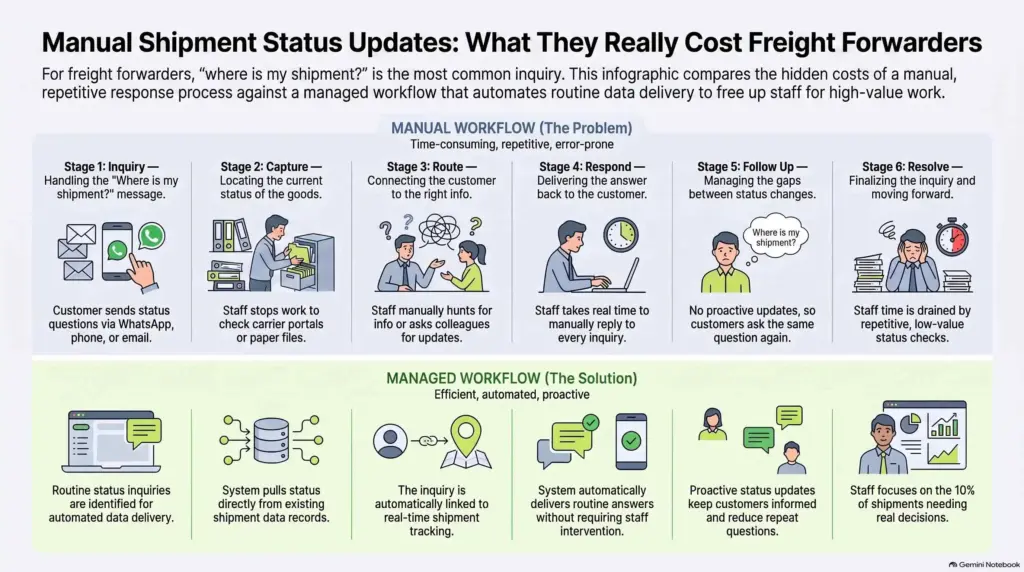
For most shipping businesses, the sequence looks something like this:
- A customer messages, usually on WhatsApp, phone, or email, asking where their shipment is.
- Someone on your team stops what they’re doing to manually check the shipment’s status, a tracking number, a carrier portal, a paper file, or a colleague who might know.
- They reply with an answer, which takes real time even when the answer is simple.
- Days later, with no proactive update in between, the same customer, or a different one on a similar timeline, asks again.
- Multiply that across every active shipment, and status requests become a steady background task competing with the rest of the day’s work.
None of this shows up as a single dramatic failure. It’s a slow, repeated drain that’s easy to underestimate because each individual reply only takes a few minutes.
It’s Not the Question, It’s the Repetition
Here’s the pattern worth sitting with: the cost isn’t any one status request. It’s answering the same question, one shipment at a time, dozens of times a week, using a process that requires a person to manually look something up every time.
From inside the business, each reply feels small, “just a quick check.” But those quick checks stack up across every customer, every shipment, every day goods are in transit. The business absorbs that cost quietly, a few minutes at a time, without ever seeing it as a single line item worth fixing.
Meanwhile, the customer experience on the other end is inconsistent: sometimes a fast reply, sometimes a slow one, depending on who’s available and how busy they are, which shapes whether that customer trusts you with the next shipment.
What Manual Status Updates Actually Cost
For a shipping business, handling status requests manually tends to show up in a few concrete ways:
- Staff time that’s hard to seea few minutes per request feels negligible until it’s multiplied across every active shipment, every week, and adds up to real hours pulled away from higher-value work.
- Slower responses when it actually matterswhen staff are busy fielding routine status checks, genuinely urgent issues (a customs hold, a documentation problem) can wait longer for attention than they should.
- No visibility into where the time goeswithout a record of how many status requests come in and how long they take to answer, there’s no way to see the pattern, let alone fix it.
- Peak season compounding the loadduring high-volume shipping periods, status request volume rises right when staff capacity is already stretched thinnest.
The Fix Isn’t More Staff, It’s Fewer Repeat Questions
Hiring more people to answer the same question faster doesn’t fix the underlying pattern, it just makes the repetition more expensive. What actually closes the gap is simpler: routine status questions get answered automatically from your existing shipment data, freeing your team to spend their time on shipments that actually need a person, holds, exceptions, and real decisions.
That doesn’t mean removing the personal touch from customer communication. It means the routine 90% stops competing with the 10% that actually needs a human.
If you’re not sure how much status-check volume your team is actually handling, or how much of it is repeat questions on the same shipment, that’s exactly what a Customer Inquiry & Follow-Up Assessment is built to show you.
Take a few minutes to walk through your current inquiry process and see where the time is going. Start your free Customer Inquiry & Follow-Up Assessmentno obligation, just a clear look at what’s working and what isn’t.
Frequently Asked Questions
How much time do shipping businesses actually lose to manual status updates?
It varies by shipment volume, team size, and how spread out communication channels are, so there’s no single figure that applies everywhere. What’s consistent is the pattern: each reply feels quick individually, but the cumulative time across every active shipment is usually far more than it appears from any single conversation.
Does fixing this mean removing personal contact with customers?
No. The goal is to handle the routine, repetitive share of status questions automatically so your team’s time goes toward shipments that need real judgment, holds, exceptions, and anything that actually requires a person.
Which channels do shipment status requests usually come through?
Most arrive on WhatsApp, phone calls, or email, since these are the channels customers already use throughout the shipping process. Facebook Messenger is also common for customers who first found the business through social media.
How can a shipping business find out how much status-check volume it’s actually handling?
The most reliable way is to track incoming status requests and how long each one takes to resolve, rather than relying on a general sense that “we get a lot of these.” A Customer Inquiry & Follow-Up Assessment is built to surface exactly that.
Not sure how much time status updates are actually costing your team?
A free Customer Inquiry & Follow-Up Assessment shows you exactly where communication gaps are costing you time, consistency, and customer trust.